
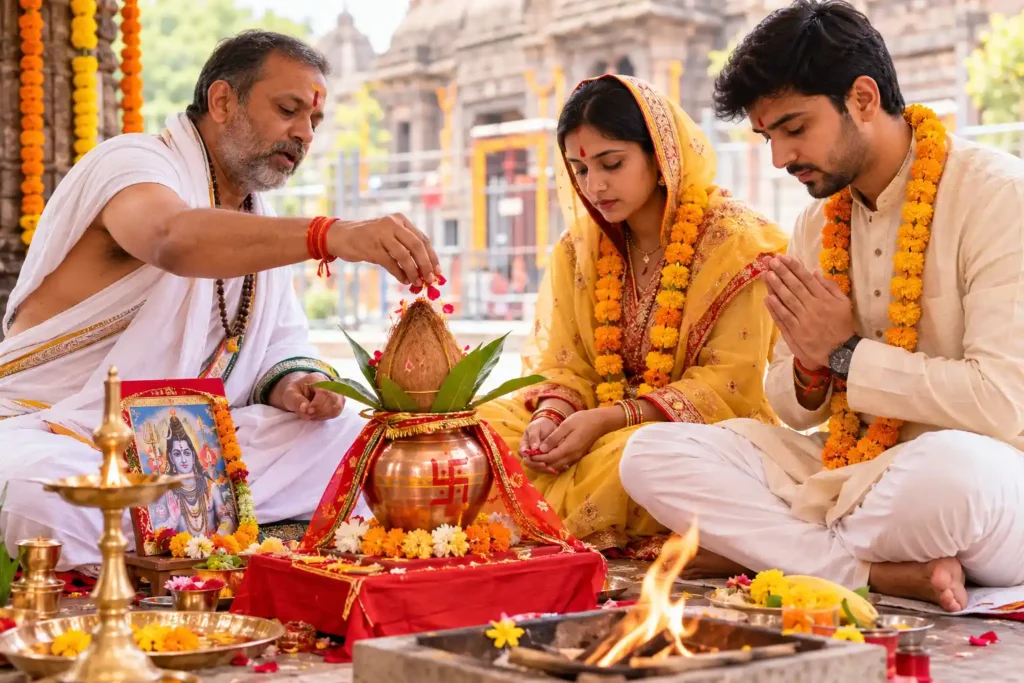
Marriage is an important milestone in Hindu tradition. Many families consult a Vedic astrologer before marriage to understand horoscope compatibility and consider any traditional rituals that may be recommended. One astrological concept discussed during this process is Manglik Dosh, also known as Mangal Dosh or Kuja Dosha.
According to Vedic astrology, Manglik Dosh is associated with the placement of Mars in particular houses of a birth chart. Some traditions recommend Kumbh Vivah Puja as a spiritual remedy when this condition is identified. The ritual involves a symbolic marriage with a sacred object, following customs that may vary by region and priestly tradition.
Trimbakeshwar, near Nashik in Maharashtra, is a significant pilgrimage destination for devotees of Lord Shiva and a place where various traditional Hindu rituals are performed.
In this guide, you will learn what Manglik Dosh means in Vedic astrology, how Kumbh Vivah Puja is traditionally performed, who may consider the ritual, its approximate duration, the factors affecting its cost, and how to enquire about booking it at Trimbakeshwar.
What Is Manglik Dosh?
Manglik Dosh, also called Mangal Dosh or Kuja Dosha, is a concept in Vedic astrology related to the position of Mars (Mangal Graha) in a person's Janam Kundli, or birth chart.
In many astrological traditions, Mars occupying the 1st, 2nd, 4th, 7th, 8th, or 12th house is considered relevant when assessing Manglik Dosh. However, the rules used to identify the condition can differ between astrological schools.
Mars is traditionally associated with energy, courage, ambition, assertiveness, and action. Some astrologers interpret particular placements of Mars as potential challenges in relationships or married life. These interpretations belong to astrology and are not scientifically established predictions of relationship outcomes.
A person's horoscope is not usually assessed from Mars's placement alone. Astrologers may also examine the ascendant, Moon chart, planetary aspects, house strength, and combinations believed to reduce or cancel Manglik Dosh.
Houses Commonly Considered in Manglik Dosh Analysis
| Birth chart house | Traditional astrological association |
|---|---|
| 1st house | Personality and individual approach to relationships |
| 2nd house | Family life and household matters |
| 4th house | Home and domestic life |
| 7th house | Marriage and partnerships |
| 8th house | Shared responsibilities and major life changes |
| 12th house | Private life and intimacy |
These are traditional astrological associations, not evidence that a particular planetary placement causes marital problems.
What Causes Manglik Dosh According to Vedic Astrology?
According to traditional Vedic astrology, Manglik Dosh is identified by examining Mars's position in the birth chart using the rules followed by the astrologer. The assessment may include:
- The position of Mars relative to the ascendant.
- The placement of Mars in the Moon chart.
- The condition of the seventh house associated with marriage.
- Planetary conjunctions and aspects.
- The positions of Jupiter and Venus.
- Astrological combinations traditionally believed to reduce or cancel the dosha.
- Compatibility between the two partners' birth charts.
Different astrologers may interpret the same chart differently because they may follow different calculation methods or traditions. For this reason, a single online result should not be treated as a definitive assessment.
Most importantly, the label Manglik should not be used to judge someone's character or suitability as a life partner. Healthy relationships depend on factors such as mutual respect, communication, shared values, and compatibility in everyday life.
What Are the Traditionally Believed Effects of Manglik Dosh?
Some Vedic astrological interpretations associate Manglik Dosh with potential challenges involving marriage or relationships. Depending on the tradition, these may include concerns about marriage timing, disagreements, or compatibility.
Such claims are not scientifically established. A delayed marriage, a rejected proposal, a disagreement between partners, or a financial difficulty does not prove that someone has Manglik Dosh.
Common Concerns Discussed in Astrology
| Area | Traditional interpretation |
|---|---|
| Marriage timing | Possible delay in finding a suitable match |
| Relationship compatibility | Need to assess temperament and compatibility |
| Domestic life | Concerns about harmony within the household |
| Emotional responses | Traditional associations with impatience or assertiveness |
These interpretations should not create fear or pressure to marry, postpone marriage, or reject a potential partner. Couples should make relationship decisions based on their values, mutual consent, compatibility, and personal circumstances.
How Can You Know Whether You Are Manglik?
A traditional Manglik Dosh assessment requires a Janam Kundli prepared using accurate birth details. An astrologer may request:
- Date of birth.
- Exact time of birth.
- Place of birth.
- Existing birth chart, if available.
The astrologer then examines Mars's position and other chart factors according to their chosen astrological tradition. They may also review the charts of both prospective partners when conducting Kundli Milan.
If a remedy is suggested, ask the astrologer to explain the reasoning, the tradition being followed, and whether any cancellation factors have been considered. You should not feel pressured to purchase a ritual simply because an online calculator labels you Manglik.
What Is Kumbh Vivah Puja?
Kumbh Vivah Puja is a traditional Hindu ritual associated with certain interpretations of Manglik Dosh. It is generally performed before a person's actual marriage when the ritual is recommended within the astrological and religious tradition they follow.
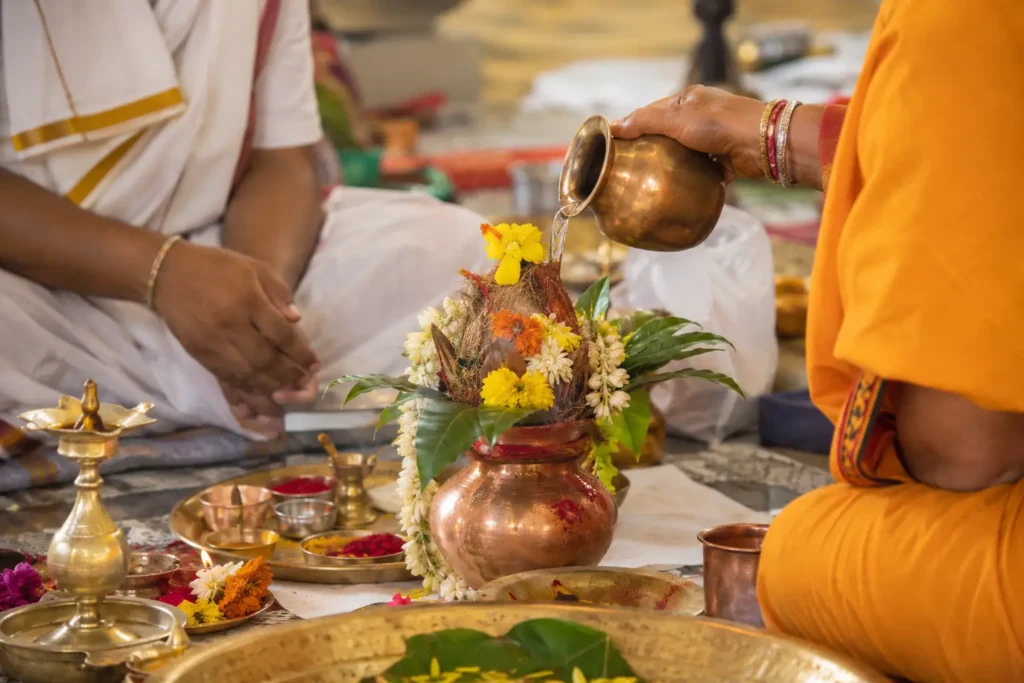
The ceremony involves a symbolic marriage with a sacred object. Depending on regional customs and the priest's tradition, this may be a Kalash, a representation of Lord Vishnu, or another prescribed sacred form.
The purpose of the ritual is understood through religious belief. Devotees perform it to observe the prescribed tradition, seek divine blessings, and feel spiritually prepared for marriage.
Kumbh Vivah Puja is not a legal marriage to a person, and its religious significance should not be confused with a scientific method of changing astrological influences. The ritual does not alter a person's birth chart.
Key Details About Kumbh Vivah Puja
| Aspect | Details |
|---|---|
| Traditional purpose | A religious remedy associated with Manglik Dosh |
| Timing | Generally before the person's actual marriage |
| Ritual form | Symbolic marriage with a sacred object, according to tradition |
| Who may perform it | Men or women, where recommended within the tradition |
| Location | Trimbakeshwar is one option for arranging the ceremony |
| Duration | Often quoted as approximately 2–3 hours; confirm the actual schedule |
The exact ritual, materials, and sequence should be confirmed with the priest conducting the ceremony.
How Is Kumbh Vivah Puja Traditionally Believed to Address Manglik Dosh?
Within the traditions that recommend Kumbh Vivah, the symbolic marriage is understood as a prescribed religious remedy for the astrological concern associated with Manglik Dosh.
The priest conducts the ceremony using prayers, a Sankalp, and the symbolic marriage ritual according to the customs being followed. Other prayers or offerings may be included depending on the arrangement.
It is important to distinguish between the traditional belief and an established fact: Kumbh Vivah Puja does not change the planetary positions recorded in a birth chart, and there is no scientific evidence that it guarantees a particular marriage outcome.
Whether to undertake the ritual is a personal religious decision. If you follow Vedic astrology, discuss the recommendation with a knowledgeable practitioner and ask for a clear explanation before making arrangements.
Kumbh Vivah Puja Procedure at Trimbakeshwar
The procedure may differ according to the priest's tradition and the type of ceremony selected. A typical arrangement may include the following steps.
1. Horoscope Discussion
If the ritual is being considered as a Manglik Dosh remedy, the devotee may first discuss the horoscope assessment with an astrologer.
2. Selection of an Auspicious Date
Some families consult their priest to select a suitable date and time, known as a Muhurat, according to their tradition.
3. Ganesh Puja
The ceremony may begin with prayers to Lord Ganesha for an auspicious start.
4. Sankalp
The devotee states their intention for the ritual. The priest may ask for details such as the devotee's name and Gotra, if known.
5. Navagraha Puja and Mantra Recitation
Depending on the prescribed procedure, prayers to the Navagrahas and the recitation of sacred mantras may be included.
6. Symbolic Marriage Ritual
The central ceremony involves a symbolic union with a Kalash or another sacred object selected according to the tradition being followed.
7. Havan, Aarti and Concluding Prayers
A Havan may be included, followed by Aarti, prayers, blessings, and Prasad.
Not every Kumbh Vivah ceremony follows an identical sequence. Confirm the actual inclusions and expected duration before booking.
Who Should Consider Kumbh Vivah Puja?
Traditionally, Kumbh Vivah Puja may be recommended for a man or woman whose horoscope has been assessed as indicating Manglik Dosh, provided the astrologer or priest considers the ritual appropriate within their tradition.
It is not automatically necessary for every person classified as Manglik. Astrological interpretations vary, and some traditions recognise combinations believed to reduce or cancel the dosha.
Consider discussing the following questions before deciding:
- Has the complete birth chart been reviewed?
- Has the astrologer explained why the ritual is being recommended?
- Have relevant cancellation combinations been considered?
- Do you understand the ceremony and its cost?
- Are you choosing the ritual voluntarily, without pressure or fear?
Marriage should remain a personal decision based on consent, compatibility, and readiness. No one should be treated as unsuitable for marriage solely because of an astrological label.
Traditional Significance and Benefits of Kumbh Vivah Puja
For families who follow Vedic astrology, Kumbh Vivah Puja has religious and cultural significance. It offers a way to observe a prescribed custom before marriage and seek blessings for the next stage of life. Devotees may value the ceremony for the following reasons:
- Religious observance: Fulfils a ritual recommended within their family or spiritual tradition.
- Seeking divine blessings: Provides an opportunity to pray for a harmonious married life.
- Spiritual reassurance: May help devotees feel that they have followed a meaningful religious custom.
- Family participation: Gives relatives an opportunity to take part in a shared spiritual occasion.
- Connection with tradition: Helps preserve customs associated with Vedic astrology and Hindu worship.
These are traditional and personal meanings, not guaranteed results. The ceremony cannot promise a successful marriage, prevent disagreements, or determine how a relationship will develop.
Why Do Devotees Choose Trimbakeshwar for Kumbh Vivah Puja?
Trimbakeshwar, near Nashik in Maharashtra, is an important pilgrimage destination because it is home to one of the twelve Jyotirlingas of Lord Shiva. The town also has established traditions of Vedic worship and various religious ceremonies.
Devotees may choose to perform Kumbh Vivah Puja at Trimbakeshwar because they wish to undertake the ritual at a revered pilgrimage destination and seek guidance from local priests familiar with the ceremony.
Before selecting a service provider, confirm the priest's experience with the specific ritual, the procedure being offered, and the services included in the quoted price.
What to Confirm Before Choosing a Priest
| Item | What to ask |
|---|---|
| Ritual procedure | Which steps and prayers are included? |
| Priest's experience | Does the priest regularly conduct this ceremony? |
| Puja materials | Are the required materials included? |
| Duration | How long should you plan to be there? |
| Cost | What is the total amount payable? |
| Booking | Is advance confirmation required? |
| Additional services | Are horoscope consultation or other pujas charged separately? |
Trimbakeshwar is one possible location for the ritual; devotees should choose a location and priest based on their preferences, practical arrangements, and religious tradition.
Kumbh Vivah Puja Cost in Trimbakeshwar
The cost of Kumbh Vivah Puja in Trimbakeshwar varies according to the ceremony, the priest's arrangements, the puja materials, and any additional rituals included. There is no single price that applies to every provider.
Some arrangements may include the priest's services, Sankalp, symbolic marriage ritual, mantra recitation, puja samagri, and Havan. Other services, such as horoscope consultation, additional pujas, accommodation, or transport, may be charged separately.
Factors That May Affect the Cost
| Factor | How it can affect the price |
|---|---|
| Type of ceremony | Different ritual arrangements may have different costs |
| Number of priests | Additional priests may affect the total |
| Puja samagri | Materials may be included or billed separately |
| Additional rituals | Navagraha Puja, Havan, or Mangal Shanti may add costs |
| Consultation | Horoscope assessment may be a separate service |
| Other arrangements | Accommodation and transport may not be included |
For an accurate estimate, contact the provider directly and request a written breakdown of what is included.
How to Book Kumbh Vivah Puja Online
Online enquiries can help devotees plan the ceremony before travelling to Trimbakeshwar. The process depends on the priest or service provider.
Step-by-Step Booking Process
- Contact the priest or organiser. Ask whether Kumbh Vivah Puja is available on your preferred date.
- Discuss the recommendation. If you are following an astrological remedy, explain whether your horoscope has already been assessed.
- Confirm the procedure. Ask which rituals are included and whether the ceremony follows your preferred tradition.
- Check the Muhurat. If an auspicious time is important to you, discuss the date and timing with the priest.
- Request the total cost. Confirm the puja materials, priest's fees, additional rituals, and payment terms.
- Provide the required details. Share only the information needed for the booking and Sankalp.
- Get written confirmation. Keep the booking date, reporting time, location, and agreed services for reference.
Book early if you need to coordinate travel, particularly during busy pilgrimage periods. Do not assume that a date, online payment method, or remote participation option is available until the provider confirms it.
Information Commonly Requested for Booking
The priest may request some of the following details:
- Full name.
- Date of birth.
- Time and place of birth, if needed for horoscope-related guidance.
- Gotra, if known.
- Preferred date for the ceremony.
- Contact information.
Ask why each personal detail is required before sharing it, and use a reliable contact channel.
Can NRIs Book Kumbh Vivah Puja from Abroad?
People living outside India can contact a Trimbakeshwar priest or service provider to enquire about advance booking. Communication may be possible by phone, email, or WhatsApp, depending on the provider.
Before making payment, confirm the date, location, exact ceremony, total cost, cancellation terms, and whether any remote participation option is offered. Online enquiry does not necessarily mean the ritual can be performed remotely or that live video is included.
For devotees travelling from abroad, written confirmation can help with travel planning and reduce confusion about the arrangements.
Book Kumbh Vivah PujaFrequently Asked Questions About Kumbh Vivah Puja
1. What is Manglik Dosh in Vedic astrology?
Manglik Dosh, also known as Mangal Dosh or Kuja Dosha, is a traditional astrological concept based on the placement of Mars in certain houses of a birth chart. Interpretations vary by astrological tradition, and the condition should not be treated as a scientifically established predictor of marriage problems.
2. What is Kumbh Vivah Puja?
Kumbh Vivah Puja is a traditional Hindu ritual associated with certain interpretations of Manglik Dosh. It involves a symbolic marriage with a sacred object, such as a Kalash, according to the customs followed by the priest. It is generally performed before the person's actual marriage.
3. Does Kumbh Vivah Puja remove Manglik Dosh?
According to the traditions that recommend the ritual, Kumbh Vivah is a religious remedy for Manglik Dosh. It does not change the planetary positions in a birth chart, and there is no scientific evidence that it guarantees a particular outcome. Whether to perform it is a personal religious decision.
4. Who should perform Kumbh Vivah Puja?
Both men and women may be advised to perform Kumbh Vivah Puja within traditions that recognise it as a Manglik Dosh remedy. The recommendation should be based on a complete horoscope assessment and a clear explanation of the ritual, rather than fear or an incomplete online calculation.
5. Why is Trimbakeshwar chosen for Kumbh Vivah Puja?
Trimbakeshwar is a revered pilgrimage destination in Maharashtra and is home to one of the twelve Jyotirlingas of Lord Shiva. Devotees may choose the town because of its religious significance and the availability of priests who conduct traditional Hindu rituals.
6. How long does Kumbh Vivah Puja take?
The ceremony is often estimated to take around two to three hours, although the duration varies according to the procedure, the priest's tradition, and any additional rituals. Ask the provider for the expected schedule before arranging transport or accommodation.
7. What is the cost of Kumbh Vivah Puja in Trimbakeshwar?
The cost depends on the ritual arrangement, the priest's fees, puja materials, and any additional ceremonies. Contact the provider for a current quote and ask for a breakdown of included and excluded services before confirming your booking.
8. Can I book Kumbh Vivah Puja online?
You can enquire about online booking through a priest or service provider who offers advance reservations. Confirm the available date, total cost, required details, location, and booking terms directly. Online enquiry does not automatically mean that remote participation is available.
9. Is Kumbh Vivah Puja compulsory for every Manglik person?
No. Even within Vedic astrology, recommendations differ according to the astrological tradition and the complete horoscope assessment. A person should not assume the ritual is compulsory simply because an online calculator identifies Manglik Dosh.
10. Can Kumbh Vivah Puja guarantee a happy married life?
No ritual can guarantee a particular relationship outcome. Devotees may perform Kumbh Vivah Puja to observe a religious tradition and seek blessings, but a healthy marriage also depends on mutual respect, communication, compatibility, consent, and shared responsibility.
Conclusion
Kumbh Vivah Puja is a traditional Hindu ceremony associated with certain interpretations of Manglik Dosh in Vedic astrology. For families who follow this tradition, it can be a meaningful religious observance before marriage.
Trimbakeshwar is one location where devotees may enquire about arranging the ritual. Before booking, understand the ceremony, ask why it is being recommended, confirm the cost and inclusions, and choose a priest who explains the process clearly.
Approach astrology and religious rituals as matters of personal belief. They should not create fear, pressure anyone into a marriage decision, or replace thoughtful consideration of relationship compatibility and personal choice.